


Your trailer is ready. The team is checking the final edits, someone is preparing social posts, and someone else is wondering whether the advertising budget will stretch far enough. Then Rockstar publishes a GTA video and starts a conversation far beyond its own community. It is tempting to put that down to a huge budget or infrequent posting. The history of GTA marketing reveals something more useful: successive campaigns solved different problems while consistently selling the feeling of entering a recognisable world.
Ahead of the announced 19 November 2026 release of GTA VI, we examine that journey: from a debate in the British Parliament, through Vice City’s music and Niko Bellic posters, to GTA V’s sales records and the distribution of GTA VI trailers. The release date and platforms, PS5 and Xbox Series X|S, were checked on Rockstar’s official website on 13 November 2026. [1]
This is a marketing analysis, not a blueprint for matching an AAA budget. As in our Diablo brand case study, our focus is the mechanism: what attracted attention, what built interest, and what kept the brand present between releases.
How does GTA marketing work? The short answer
GTA marketing combines a consistent promise about its world, a distinct identity for each instalment, announcements designed as events, and material that can circulate beyond the publisher’s own channels. Over time, GTA Online added ongoing contact with players. The impact of today’s GTA announcements also comes from earlier games, brand recognition and years of cultural presence. It cannot be attributed to a posting schedule alone.
Throughout this article, we separate facts, historical accounts and our interpretation. Sales figures do not prove the effectiveness of a single advertisement. View counts do not represent unique players, and a combined development and promotion budget is not a standalone marketing budget.
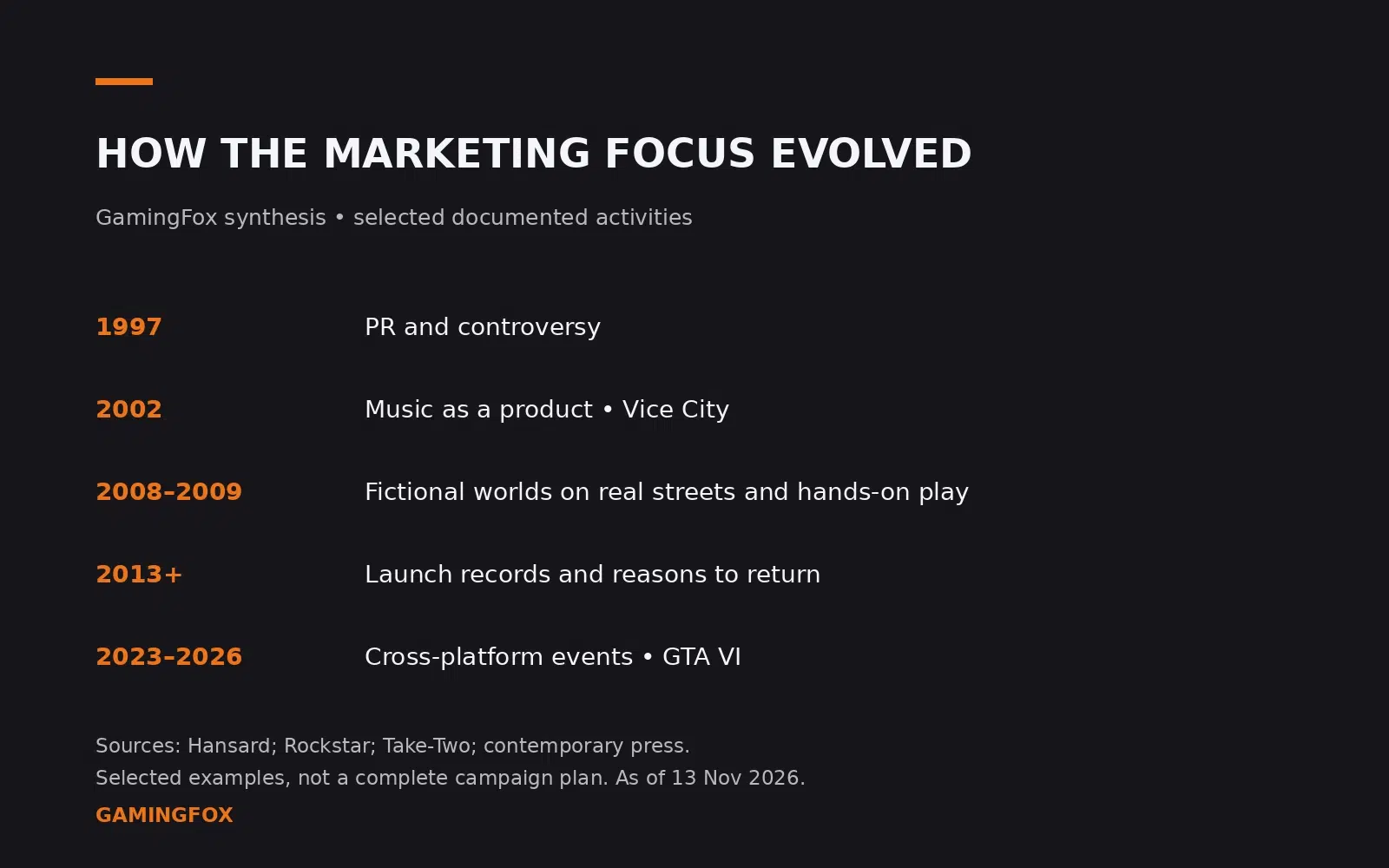
1. GTA in 1997: when critics help explain the game
Start with a scene that now sounds like a ready-made campaign concept. On 20 May 1997, Grand Theft Auto was the subject of a question in the House of Lords, before its release. The official Hansard record contains concerns about the crime depicted in the game, police chases and children’s access to this kind of entertainment. This is a contemporary document, rather than a marketing legend invented later. [2]
How media interest was encouraged is a separate question. A 2012 Game Developer report, referring to a Sunday Times interview with the game’s co-creators, recounts Mike Dailly and David Jones’s description of publicist Max Clifford’s role in generating controversy around the original GTA. The distinction matters: the parliamentary record confirms the debate, while the story of orchestrated publicity is a later account from people involved. [3]
Controversy as positioning
From a marketing perspective, criticism of the game could also communicate what made it different. For some adult audiences, a game that worried institutions signalled entertainment that challenged contemporary expectations. Its opponents described the product in terms that potential players might find appealing.
That does not mean every scandal increases sales. We do not have an experiment showing how many copies of the first GTA sold because of a particular newspaper article. We have a history of its communication and accounts from people involved in making it. These support a hypothesis about how interest developed, not a reliable calculation of PR returns.
The useful lesson for an indie studio is clear positioning. If your game challenges a genre convention, show a specific example. A strategy game in which defeat changes the world offers a stronger hook than a claim to deliver a “unique experience”. You need a reason to talk that comes from the product itself. Provocation alone cannot replace it.
2. GTA III, Vice City and San Andreas: one brand, different player fantasies
Looking back at this period of GTA history, it is easy to focus on the shift in camera perspective and increasingly large worlds. From a marketing standpoint, distinguishing each instalment matters just as much. Liberty City, Vice City and San Andreas do not sound like interchangeable maps for the same product. Each evokes different associations with a place, music, characters and culture.
Our interpretation of the series’ materials and identity is that Rockstar retained the recognisable GTA umbrella while giving each new instalment its own character. A sequel could therefore benefit from existing trust and still answer the question: why should someone care about this particular game?
For a developer, this decision is harder than it looks. If a new project is too similar to the previous one, its marketing may offer little reason to buy. If it abandons every recognisable element, the team must explain what to expect all over again. A clear brand structure preserves familiarity while leaving room for change.
Vice City sold its atmosphere beyond the game
The Vice City soundtrack is a concrete example of extending beyond conventional advertising. In September 2002, Rockstar Games and Sony Music announced a collaboration on seven albums, timed to the game’s US launch on 29 October. The contemporary report of the announcement also names Epic Records. [4]
Music was more than a backdrop for promotional material. It could become a product in its own right and another encounter with the brand. Instead of repeatedly buying attention in a new place, the brand offered something people could return to voluntarily.
We do not have a public breakdown of licensing costs or the albums’ effect on Vice City sales. Calling this the “most profitable campaign” would therefore go beyond the evidence. What we can identify is the structure: part of the game’s world became an experience people could enjoy outside the game.
An original soundtrack, fictional newspaper or short story set in your universe can serve a similar purpose for an indie game. The material needs value even when its audience is not looking for an advertisement. A file with a logo on it does not, by itself, create another reason to care.
3. GTA IV: bringing a fictional world onto real streets
Before GTA IV launched, stylised wanted posters featuring its characters appeared in New York. GamesRadar reported on the campaign on 1 February 2008, mentioning Niko Bellic among others. This is contemporary press coverage, not an official performance report. [5]
The idea is more interesting than simply enlarging the cover art. The poster resembles an object from the fictional world. A passer-by encounters part of the story in a real setting. A photograph can then travel online, creating another layer of distribution.
Advertising as part of the world
This mechanism is sometimes called diegetic marketing: the message takes the form of something that could exist inside the fictional universe. You do not need the terminology to use the idea. A horror game might use a fictional missing-person notice, a business simulation a company report, and a detective game an extract from a case file.
What matters is continuity between the promise and the experience. If a piece of marketing promises an intriguing mystery, the next click should develop it or explain the game clearly. A generic page unrelated to the original material gives that curiosity nowhere to go.
Work backwards when planning such a campaign: where should it lead, what will players see there, and what can they do next? Choose the format after answering those questions. In public spaces, make the fictional context clear so the material is not mistaken for a real emergency notice.
Launch figures show scale, not the impact of one poster
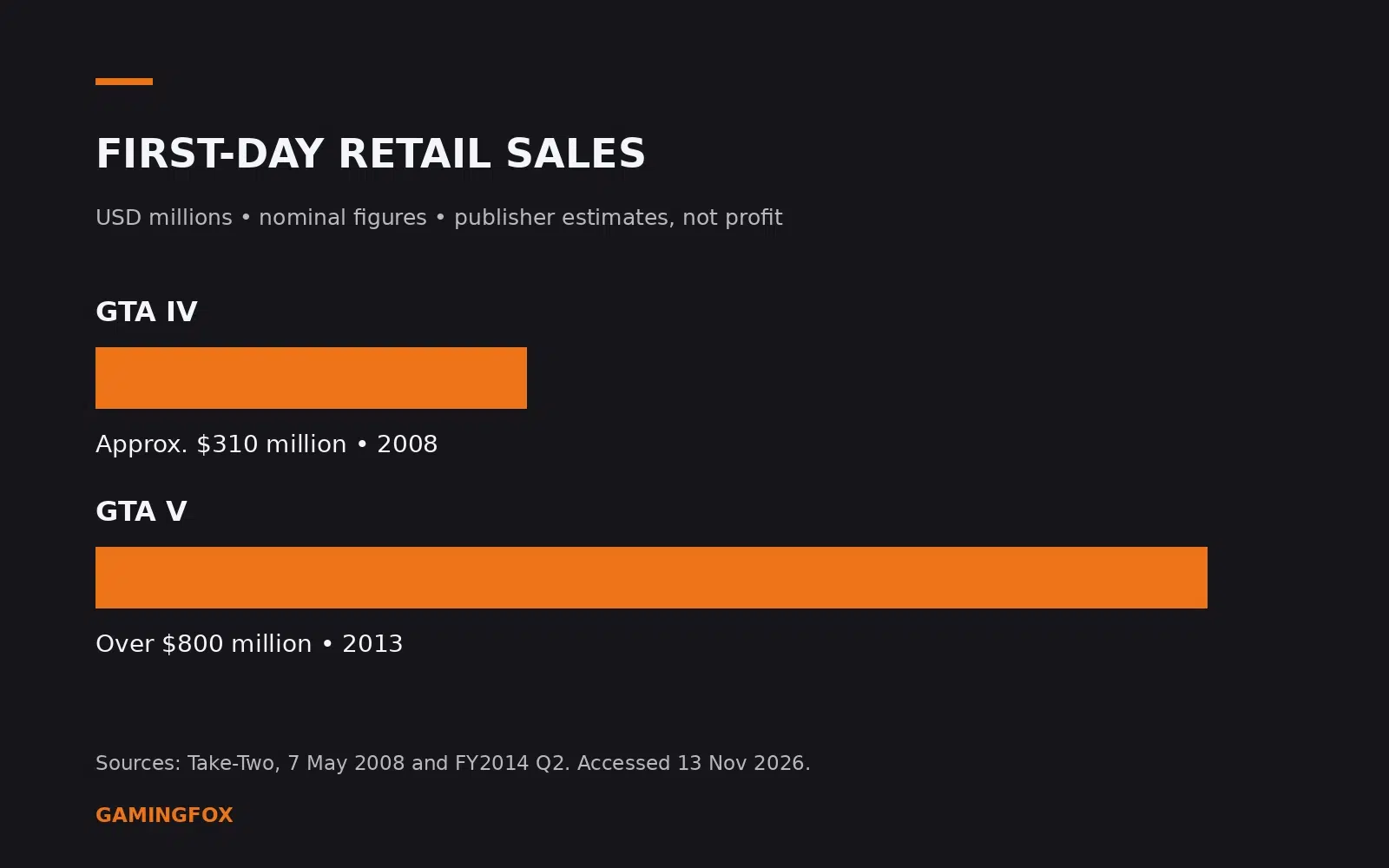
Take-Two reported that GTA IV sold approximately 3.6 million copies on its first day, representing estimated retail sales of around US$310 million. First-week figures reached approximately 6 million copies and over US$500 million. The announcement was dated 7 May 2008. [6]
These figures show the scale of the launch. They do not establish the individual contribution of posters, trailers, reviews or the series’ reputation. Different activities may have reinforced each other. Attributing the entire result to one memorable activation would make an appealing story but a weak analysis.
4. Chinatown Wars: more than posting a trailer and disappearing
Rockstar’s marketing is sometimes reduced to a long silence followed by one huge announcement. Chinatown Wars complicates that picture. In September 2009, Rockstar described a promotional van tour: earlier US stops had included demonstrations of the Nintendo DS version, stickers and limited-edition T-shirts, while the announcement pointed towards further activity around the PSP release. [7]
This is experiential marketing. People do more than see a message about a game: they encounter the product, interact with the brand and take away a reminder. For a handheld game, seeing it in action answers different questions from watching a major online trailer.
A small studio does not need a vehicle touring the country to apply the lesson. A well-prepared stand at an industry event can serve a similar purpose. Before ordering merchandise, decide what should happen after someone plays the demo. Will they remember the title? Can they explain what makes it different? Do they know where to find it?
Handing out materials does not prove effectiveness. Useful measurement would include completed play sessions, the quality of conversations, visits through a dedicated URL and actions on the store page. This is our suggested evaluation framework, not a set of published results from Rockstar’s tour.
5. GTA V: when launch sales become the next marketing story
An established brand can turn sales performance into another media event. GTA V is a strong example of that loop. Take-Two’s official materials reported over US$800 million in retail sales during the first 24 hours. On 20 September 2013, the company announced that the game had exceeded US$1 billion in its first three days. These figures were company estimates. [8][9]
At this stage, success does not end the conversation. It becomes the next story: media report the record, players discuss the scale of the launch, and people who were undecided encounter the game again. The result signals popularity, although it does not prove that everyone will enjoy the game.
Interest needs a clear explanation of the product
GTA V’s campaign did more than establish an atmosphere. Official announcements also explained the experience, including its three protagonists. A separate GTA Online gameplay video, published on 15 August 2013, showed multiplayer possibilities and announced a 1 October launch for the service. [10][11]
These materials have different jobs. Some should make people want to enter the world; others should explain what they will do there. Marketing built entirely around atmosphere may leave the product unclear. Marketing that only explains systems may fail to provide an emotional reason to care.
Ask two questions about your own trailer: what player fantasy does it evoke, and what footage demonstrates that the game actually delivers it? If answering the second question requires a separate developer presentation, the trailer may need clearer gameplay.
What can we compare between GTA IV and GTA V?
| Metric | GTA IV, 2008 | GTA V, 2013 |
|---|---|---|
| Retail sales in the first 24 hours | Approx. US$310 million | Over US$800 million |
| Additional milestone | Over US$500 million in one week | Over US$1 billion in three days |
| Source type | Take-Two estimate | Take-Two estimate |
The first row uses the same time window and unit. The second shows two different milestones and cannot be used to calculate percentage growth. These are nominal figures, without inflation adjustments. They are neither publisher profit nor revenue attributed to a specific advertising campaign.
6. How much did GTA marketing cost? Be careful with the £170 million figure
The figure of £170 million frequently appears in discussions of GTA V. Guinness World Records describes it as the combined development and marketing budget in 2013 and gives a US$276 million equivalent. Press reports also use an approximate US$265 million conversion. Keeping the figure in pounds and stating its scope explicitly is the clearest approach. [12]
We do not present this historical figure as an audited Rockstar expenditure report. There is no public breakdown here for production, media buying, creative work, licensing and other activities. In particular, it does not justify saying that Rockstar spent £170 million on GTA V advertisements.
Why does this not give us campaign ROI?
Dividing a billion dollars in sales by an approximate budget looks impressive, but it does not calculate marketing ROI. The numerator and denominator describe different things. Retail sales are not profit, and the total cost of developing and promoting a game is not the cost of one campaign. We also do not know what would have happened without those activities.
The same caution applies to speculation about billion-dollar GTA VI costs. The verified materials used in this analysis do not disclose a separate marketing budget for the game. An undisclosed figure remains undisclosed, even when a very precise number circulates online.
For your own studio, the practical lesson is to record costs so that you can answer specific questions later. Separate asset production, distribution, management and measurement. We explain this approach in our guide to indie game marketing costs.
7. GTA Online: keeping the brand active between major releases
A standalone game launch and an evolving live service have different communication rhythms. The former concentrates attention around a date. The latter must repeatedly answer a player’s question: why should I return now?
In its November 2026 investor presentation, Take-Two described GTA Online as a world expanded through regular free updates. The same presentation put GTA V at nearly 235 million copies sold and the series at nearly 480 million. The company uses sell-in terminology in historical reporting; these figures should not be equated with unique people. [13]
An update gives marketers another reason to contact players, but its role extends beyond the publisher’s announcement. Players can tell their own stories, create videos and return with friends. This is our interpretation of the role of an evolving product, not an estimate of the percentage of GTA V sales generated by GTA Online.
For indie teams, the crucial question is the scale of the commitment. Not every game needs years of live-service support. Planning one meaningful update and its communication is more realistic than promising regular expansions the team cannot deliver. The reason to return must first exist in the product.
8. GTA VI: trailer records and the trap of easy comparisons
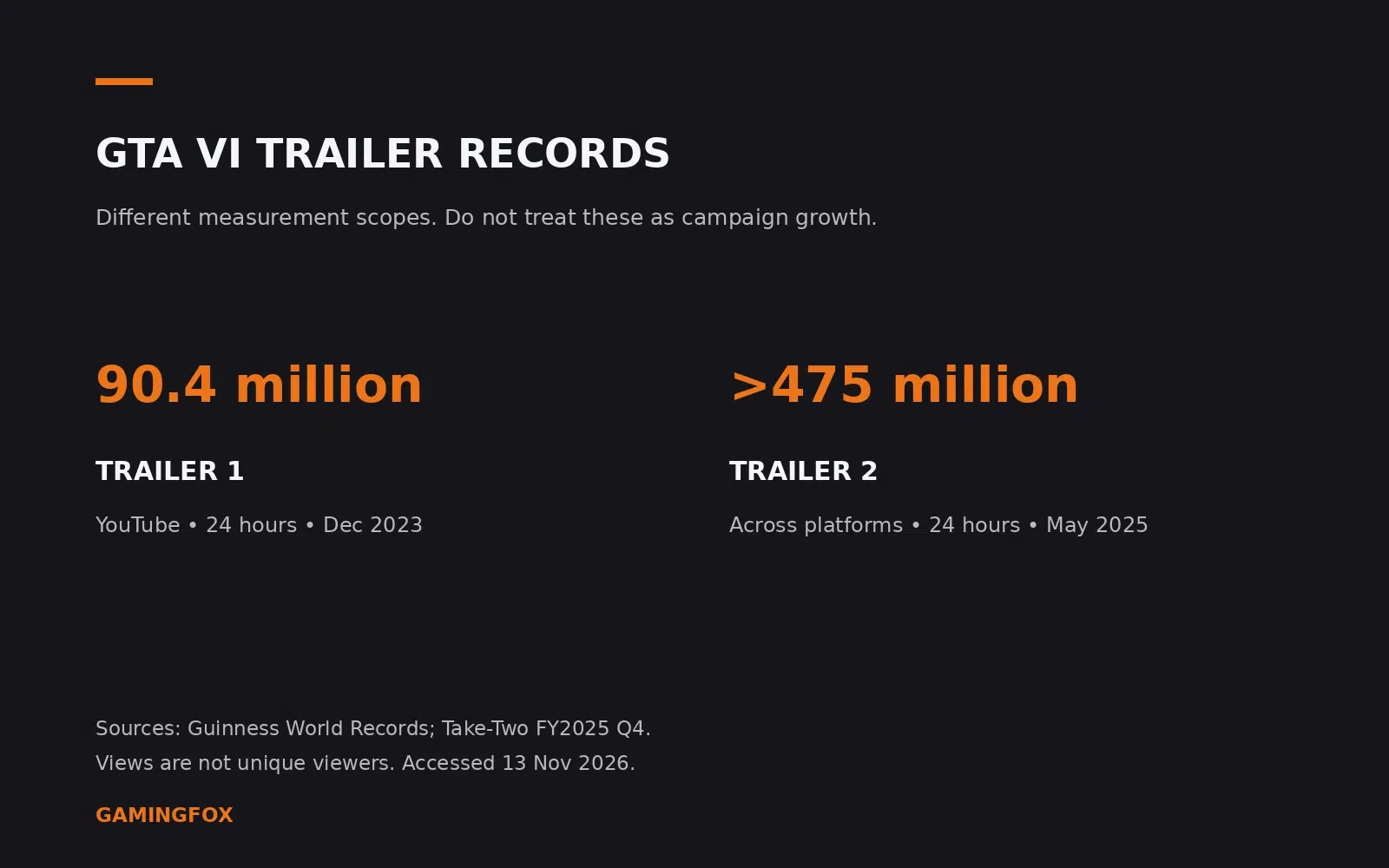
The first GTA VI trailer produced a precisely documented result. Guinness recorded 90,421,491 YouTube views in 24 hours and 8.9 million likes during that window. This is a historical measurement from the trailer’s December 2023 release, not its current view count. [14]
Such an opening demonstrates enormous distribution. It does not tell us how many unique people watched, how many will buy the game, or how many views came from repeat watching. People may watch for enjoyment, to analyse details or to participate in a conversation. These behaviours have communication value, but they are not a single sales metric.
Trailer 2: over 475 million views across multiple platforms
In its prepared remarks for fiscal 2025 results, Take-Two reported over 475 million views of the second trailer within 24 hours across platforms. The same statement cited 93 million YouTube views for the first trailer, a different reading from Guinness’s precise record. We do not combine these figures into a supposedly uniform data series. [15]
| Video | Reported result | Where and when? | What remains unknown? |
|---|---|---|---|
| GTA VI, Trailer 1 | 90,421,491 | YouTube, first 24 hours, December 2023; Guinness | Unique viewers and purchase impact |
| GTA VI, Trailer 2 | Over 475 million | Across platforms, first 24 hours, May 2025; Take-Two | Full aggregation methodology and deduplication |
These numbers do not establish that the second campaign was more than five times as effective. The channels, definitions and counting methods would first need to be aligned. That distinction matters as much as the record: distribution and reporting methodology shape what we subsequently call success.
Music travels beyond the game again
Take-Two also reported a 182,000% increase in Spotify streams of The Pointer Sisters’ “Hot Together” after its use in the second trailer. The statement does not provide the full baseline period or the number of streams before the increase. We treat it as a reported indicator of interest in the song, not a measure of GTA VI sales. [15]
This connects back to Vice City: music can carry a brand’s identity, and interest in a trailer can spread to other content. It does not follow that licensing a familiar track will automatically generate reach for a game. The strength of an already recognisable series also matters here.
9. Is silence Rockstar’s secret?
Silence matters when somebody is waiting for an answer. For an unknown game, a lack of communication may simply mean no contact with potential players. For an established series, a gap between major announcements can sustain curiosity. These are very different starting positions.
The more useful lesson is to plan the value of each announcement. A release can reveal a character, explain a system or provide a date that helps players make a decision. It moves their understanding forward. If the only news is that the studio is still working, they may have little reason to respond.
Rockstar also communicates through more than trailers. At the time of our review, the GTA VI website had separate areas for music, images and world information, as well as a route to purchase. This is an observation of the site’s structure on the verification date, not evidence that we know the company’s full media plan. [1]
We do not know the campaign-wide balance of paid and organic reach. Saying that GTA “markets itself” overlooks the cost of producing materials, maintaining channels, managing distribution and building the brand in earlier years. Attention earned over decades is not a resource available to every new project.
10. What can indie studios learn from GTA marketing?
The following framework is GamingFox’s recommendation based on this analysis. It is not Rockstar’s disclosed operating manual or a promise of comparable results.
Step 1: define a promise you can show
Write one sentence describing the player experience. Then identify a scene that demonstrates it. In a heist-planning game, it might be the moment several simple decisions combine into one satisfying plan. If the promise only becomes clear after an hour of explanation, it is difficult to use for a first encounter with the game.
Compare two versions of a short asset with people who fit your target audience. Ask what they understood and what they are looking forward to. Do not suggest the answers. You are checking whether the team’s promise matches the audience’s interpretation. Our guide to defining a game’s target audience explores this stage in more detail.
Step 2: choose one distinctive element of your world
It could be the music, the language of in-world notices, a way of presenting characters or an important story object. Build several useful assets around it. The aim is recognition, not simply more formats. Your artwork, trailer and store page should express the same promise.
Check whether the material makes sense to someone unfamiliar with the game. A person outside your Discord community will not know a fictional faction’s name or why a small character change matters. Help them enter the story before relying on the team’s internal shorthand.
Step 3: give each release a clear job
A reveal should create interest. Gameplay should explain the experience. A demo should let people test it. A release-date announcement should help them plan a purchase. These jobs can overlap, but you should know which problem each piece of communication addresses.
Create a simple table: asset, player question, destination and intended action. If someone watches the trailer but cannot tell where to find the game, improve the path. If the store page describes a different experience from the video, fix that mismatch before buying more traffic.
Step 4: measure movement between stages
Views help assess distribution, but they do not replace evidence of interest in the product. Track store visits, actions attributed to traffic sources, demo responses and the questions players ask. Allow for attribution limits and the fact that some people return through another route.
With a small sample, do not build certainty around a single spike. Record what changed: the creative, audience, channel or timing. If everything changes at once, the result may be good while the explanation remains weak. Cost and test scope matter as much as the headline outcome.
Step 5: plan a reason for the next interaction
Do not end the plan on trailer release day. Decide what someone discovering the game a week later will see, and what you can show at the next milestone. A reason to return should come from product development: a demo, playtest, launch or meaningful update.
You do not need to fill every quiet period with a post. You do need a realistic plan for delivering value and a place where interested players can find current information. A small team can apply this approach without pretending to have Rockstar’s starting position.
FAQ: GTA marketing, budgets and records
When is GTA VI scheduled for release?
According to Rockstar Games’ official website, checked on 13 November 2026, the announced release date was 19 November 2026 for PS5 and Xbox Series X|S. This reflects the announcement at the verification date and is not a PC release announcement. [1]
How much did GTA V marketing cost?
We do not have a separate confirmed figure. The frequently cited £170 million covers development and marketing together. The Guinness source does not establish how much was spent on advertising. [12]
How many views did the first GTA VI trailer get in 24 hours?
Guinness recorded 90,421,491 YouTube views in the first 24 hours. This is the historical measurement window from December 2023, not the video’s current total. [14]
Do 475 million trailer views mean 475 million people?
No. Take-Two reported views across multiple platforms. Without unique-viewer data and deduplication, that total cannot be treated as a number of people or compared directly with a YouTube-only figure. [15]
Should indie studios copy Rockstar’s long silences?
Do not copy a schedule without considering awareness of your own game. Borrow the planning of meaningful reveals and a coherent world identity, then set a frequency that suits your audience and your team’s capacity.
How can you apply these lessons to your game?
GTA’s history shows that a campaign can include much more than advertisements: music, an object from the fictional world, a demo experience, a launch record and a reason to return after an update. Their value depends on their connection to what players actually want from the product.
At GamingFox, we help game developers align their audience, promise, assets and path to a decision. If you are preparing a launch, book a consultation. We will discuss what players need to see before you decide where to spend money reaching them.
Sources and methodology
Verified as of 13 November 2026. This analysis covers selected documented activities, not the series’ complete media plan. Earlier campaigns are described using archives, participant accounts and contemporary reporting. Recent figures come from official Rockstar, Take-Two and Guinness materials. Our conclusions are not a causal measurement of campaign effectiveness. Historical monetary figures are nominal. Retail sales, sell-in, views and likes remain separate metrics.
[1] Rockstar Games: current GTA VI website. 13 November 2026. Release date and website structure; subject to change.
[2] Hansard: GTA debate. 20 May 1997. Original parliamentary record; does not demonstrate sales impact.
[3] Game Developer: creators’ account of the PR campaign. 22 October 2012. Secondary reporting of an interview and participants’ recollections.
[4] Worthplaying: Vice City soundtrack announcement. 9 September 2002. Seven albums; partners’ pre-launch announcement.
[5] GamesRadar: GTA IV posters. 1 February 2008. Contemporary campaign reporting, without conversion results.
[6] Take-Two: GTA IV launch results. 7 May 2008. Approx. 3.6 million copies/US$310 million on day one; 6 million/over US$500 million in week one. Sell-through estimates.
[7] Rockstar: Chinatown Wars tour. 10 September 2009. Official description of activity, without quantitative results.
[8] Take-Two: FY2014 Q2 results. 2013. GTA V: over US$800 million in retail sales in the first 24 hours; not profit.
[9] Take-Two: GTA V exceeds US$1 billion. 20 September 2013. Over US$1 billion in retail sales in three days; company estimates.
[10] Take-Two: GTA V release date. 31 January 2013. Communication of the three protagonists.
[11] Rockstar: GTA Online gameplay. 15 August 2013. Announcement scope and 1 October 2013 service launch.
[12] Guinness: historical GTA V budget. 9 September 2013. £170 million for development and marketing combined; neither an audit nor a separate advertising budget.
[13] Take-Two: November 2026 investor presentation. November 2026. Nearly 235 million GTA V copies and 480 million across the series; not unique players.
[14] Guinness: first GTA VI trailer record. 6 December 2023. 90,421,491 views and 8.9 million likes on YouTube in 24 hours; historical measurement.
[15] Take-Two: FY2025 Q4 prepared remarks. May 2025. Trailer 2: over 475 million cross-platform views in 24 hours. Spotify increase of 182,000% without a full baseline. The release date in this older document is superseded.