

If you’re a solo dev or a small studio, that’s good news. Because you don’t have to copy AAA budgets to copy the mechanism. You can take from Diablo what actually did the heavy lifting: the way it built trust, the sequence of “first touchpoint → return → event → system,” and how Blizzard designed its marketing around player behavior—not around its own messaging.
In this article, I break Diablo’s marketing down into stages and map them to classic frameworks like AIDA, the funnel, STP, 4P, and “moment marketing” (events that generate reach on their own). At the end, you’ll find practical takeaways for indie devs, plus examples of “big” plays that weren’t your typical industry moves.
This is a case study in game marketing that showcases Diablo brand marketing and brand building in gamedev over 30 years. If you’re interested in indie game marketing, treat this as a practical framework for your own game marketing strategy.
Why Diablo brand marketing is a great case study for game marketing
Most brands in gamedev grow unevenly. One part stalls, another breaks through, and communication can get chaotic. Diablo is the opposite. It’s a brand that, over the years, learned how to:
-
build a habit of coming back (for those who already tried it)
-
build a habit of coming back (for those who already tried it),
-
turn launches into events (for the broader market),
-
produce “proof of popularity” (that fuels PR and recommendations).
That’s exactly what classic marketing frameworks describe.
AIDA in practice (Attention, Interest, Desire, Action)
Over the years, Diablo shifted emphasis between stages:
-
when the brand was unknown: it made Action as easy as possible (try it, play it, feel it),
-
when the brand was big: it boosted Attention and Desire (events, scale, social proof).
Funnel and the “pirate” AARRR metric
In games, it’s brutally simple:
-
Acquisition: how someone discovers the game at all,
-
Activation: whether the first 10–30 minutes “click,”
-
Retention: whether they come back,
-
Revenue: whether they buy or keep paying,
-
Referral: whether they recommend it.
Diablo has always treated marketing as designing that path, not as a series of pretty messages. If your game is on Steam, the simplest way to tie this together is by tracking clicks and traffic sources with UTM parameters in Steamworks.
“Brand doesn’t exist yet” stage: Diablo 1 and selling through proof
What was the challenge in 1996/97?
In the 1990s, the biggest problem for a new IP wasn’t a lack of ads—it was a lack of trust. A player needed a reason to risk their time and money.
Blizzard (still without the “empire aura” back then) needed a tool that marketing calls risk reversal: shifting the risk onto the seller.
Tactic: a demo as the cheapest “proof of value”
This isn’t just a historical detail. It’s a mechanism that still works today—especially in indie.
Diablo’s demo was designed like a funnel:
-
give the player a low-friction entry point,
-
show the core loop (combat, loot, progression),
-
leave them wanting more,
-
let the player sell the product… to themselves.
For small studios, this is one of the most important lessons in game marketing: if you don’t have the budget for reach, you need a product that is marketing. A demo, a prologue, a playtest, a vertical slice—the label is secondary. What matters is the “proof” and a well-defined game marketing strategy already at the stage of building the first experience.
How this maps to the 4Ps
-
Product: the core loop and atmosphere,
-
Price: in practice, the “barrier to entry” (a demo drops it to zero),
-
Place: distributing demos through channels where players already were,
-
Promotion: PR and recommendations built on the experience.
From a 2026 perspective, the most interesting part is that this tactic is inherently “indie.” A good demo doesn’t require a huge budget. It requires selection: what you show in 10 minutes, and what you save for later.
“Brand already known” stage: Diablo II and the moment when numbers become advertising
In Diablo II, Blizzard moved from the problem of “will anyone try it?” to the problem of “how do we turn the launch into an event?”
Here we get into a model that always works in marketing, regardless of the industry: social proof. In games, it has uniquely high value, because people don’t buy just a product. They also buy the feeling that they’re “part of the conversation,” that you kind of *should* know it, that friends are playing too.
Tactic: using data as PR fuel
Diablo II very quickly communicated record-breaking sales velocity:
-
184k copies on launch day,
-
1 million in 2 weeks,
-
2 million after about 1.5 months.
These are numbers that don’t necessarily have to “convince” anyone the game is good. They do something else: they create pressure to stay up to date. This is the moment when marketing stops being persuasion and becomes “event coverage.”
Tactic: Collector’s Edition as a segmentation tool
In classic STP (Segmentation–Targeting–Positioning), it’s simple:
-
some players just want to play,
-
some want belonging and prestige,
-
some want to collect.
A Collector’s Edition isn’t just merch. It’s a product for the “most engaged” segment that:
-
increases average basket value,
-
reinforces positioning (“this is an important brand”),
-
adds an extra reason to buy “now.”
A lesson for indie games
Indie won’t sell 184k copies on day one. And it doesn’t have to.
But indie can apply the same segmentation logic that sits at the core of indie game marketing:
-
regular edition,
-
a creator-supporting deluxe edition,
-
a bundle with an artbook/soundtrack,
-
limited community rewards.
The point is to give fans a way to go one level deeper—even if the scale is small.
Stage “global hype”: Diablo III and the most “AAA” trick in this story
Diablo III is the perfect moment to show the difference between indie vs AAA in a single sentence:
AAA doesn’t win only with budget. AAA wins with an ecosystem.
Tactic: distribution through its own portfolio (WoW Annual Pass)
Blizzard made a move that most studios can’t copy 1:1, but the mechanism is worth understanding.
The World of Warcraft Annual Pass offered, among other things, a free copy of Diablo III. From a marketing perspective, it’s a masterstroke, because it:
-
shifts the purchase decision to a different product,
-
builds a Diablo player base before the game “fully” launches,
-
strengthens loyalty to the entire Blizzard platform.
This is a classic example of bundling and cross-selling within a portfolio, and from the perspective of brand building in gamedev, it shows the power of an ecosystem. A brand grows faster when you have more than one distribution channel and more than one touchpoint with the player.
Tactic: sales records as a PR tool
Diablo III sold 3.5 million copies in its first 24 hours, and an additional 1.2 million players received the game through the Annual Pass. In practice, a record becomes a message that takes on a life of its own. The media quotes it, the community repeats it, and the undecided get a signal: “this is the launch of the season.”
What this teaches indie
You can’t copy the Annual Pass, but you can copy the idea of a “distribution channel.”
In indie, the equivalents are:
-
festivals (Steam Next Fest),
-
bundles (e.g., themed bundles),
-
collaborations and cross-promotions with other creators,
-
a publisher network,
-
platform featuring.
The mechanism is the same: you’re not “adding more reach,” you’re opening a new entry channel into the funnel—which directly supports your game marketing strategy on small budgets.
If you’re getting ready for a festival, also check out our practical guide: 5 ways to make your game stand out during Steam Next Fest.
Stage “marketing as a system”: Diablo IV, the beta as a campaign, and data as content
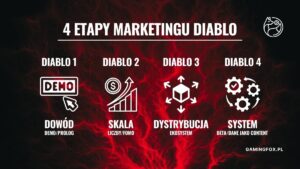
If Diablo I was “marketing through proof,” and Diablo II–III was “marketing through events,” then Diablo IV is “marketing as a system.”
In this era:
-
beta isn’t a test—it’s part of the funnel,
-
statistics aren’t a report—they’re content,
-
and launch is the starting point of a live service, not the end of a campaign.
Tactic: beta as a controlled moment of mass entry
Blizzard published beta data that carries the message on its own:
-
around 61.5 million hours played in the beta,
-
around 2.6 million players who reached level 20 for the reward.
Why does this work from a marketing perspective? Because numbers do two things at once:
-
build social legitimacy (“this is big”),
-
create a ready-made narrative for media and socials (“this is an event”).
This is data-driven content marketing. And it’s a trend that’s been growing in gamedev for years.
Tactic: PR that sounds like part of the game’s world
After launch, Blizzard shared a number that’s both a result and a symbol: $666 million in sell-through in 5 days.
This is an example of framing: the same financial datapoint could have been boring. Here, it becomes a “Diablo story” and generates reach.
Tactic: campaigns unlike typical game marketing (Hell’s Ink)
Hell’s Ink—a tour of tattoo studios—is an example of a campaign that works because it is:
-
consistent with the brand’s DNA,
-
“photogenic” and easy to share,
-
unlike standard industry marketing.
This is classic experiential marketing and earned media. You don’t buy all the reach—you create something distinctive enough that people and media carry it for you.
Lesson for indie
You don’t have to do tattoos (seriously, you don’t), but you can think with the same framework:
-
What in my world is so distinctive that it can be taken outside the game?
-
What community “ritual” can I design (a reward, challenge, leaderboard, an in-demo event)?
-
How do I create an action players want to show off—because it fits their identity?
What Diablo did differently at each stage of brand awareness
Below is the essence of “30 years in one model,” in language that’s actually useful for creators.
When the brand is unknown (indie start)
Goal: reduce risk and deliver the first experience.
Best levers:
-
demo/prolog/playtest,
-
show the core loop very quickly,
-
a consistent, recognizable vibe (key art, description, the first 10 seconds of the trailer),
-
collect proof of quality: opinions, quotes, feedback.
This is the Activation and Retention stage in AARRR. Without it, the rest doesn’t make sense.
When the brand is recognizable (scaling)
Goal: create an event and maximize distribution.
Best levers:
-
events: beta, season, collab, a major update,
-
communicating scale: numbers, records, stats,
-
distribution through an ecosystem (partnerships, portfolio, platforms),
-
“campaigns unlike everyone else” (earned media).
Here, Attention and Desire dominate, and then Retention again (because live service).
Practical tips for solo devs and small studios: how to apply Diablo’s lessons without an AAA budget
Below are practical steps you can implement in indie even if you’re doing marketing after hours. Treat this as a mini-checklist for indie game marketing and planning your game marketing strategy.
1) Define your “proof” in one sentence
“Proof” isn’t a slogan. It’s evidence the player can see or feel.
Examples:
-
a demo that shows the core loop,
-
a public playtest with specific feedback,
-
a vertical slice that “sells the feel of the game” in 30–60 seconds.
If you can’t name your proof, your communication will be random.
2) Design the demo like a funnel, not like a “slice of the game”
The most common mistake: the demo is too long, too blurry, with no climax.
A better structure:
-
get into the vibe in 30 seconds,
-
a quick win (reward),
-
show progression,
-
an “oh, I want more” moment,
-
an end screen with a clear CTA: wishlist, Discord, playtest.
3) Build one “moment” on the calendar instead of constant talking
Diablo always had moments: launch, expansion, beta, seasons.
Indie equivalents:
-
Steam Next Fest,
-
start of a wishlist campaign,
-
a public playtest,
-
a release date reveal,
-
a major demo update.
It’s better to do one strong moment per quarter than 30 posts that change nothing.
4) Use data as content (even at a small scale)
You don’t need 61.5 million hours.
You can show:
-
wishlist count (if it’s meaningful),
-
number of playtesters,
-
demo retention (if you track it),
-
most-picked classes/builds,
-
behavior heatmaps (even described in words).
Data builds credibility. And credibility is indie currency.
5) Segment your offer, even if you only sell on Steam
Create simple tiers:
-
standard,
-
deluxe (soundtrack/artbook),
-
bundle.
This isn’t “greed.” It’s matching the product to different levels of engagement.
6) Chase earned media, not just paid reach
Hell’s Ink worked because it was consistent and “different.”
In indie, “different” doesn’t mean “weird.”
It means: distinctive to your game.
Examples:
-
a mini challenge in the demo with a reward (cosmetic, credits, community),
-
a fanart contest using your assets,
-
a collaboration with another game with a similar vibe,
-
a prologue as a separate free release.
Summary: 30 years of Diablo in one pattern
Diablo didn’t grow by accident. It grew on classic marketing logic:
-
First: proof (demo, experience, risk reduction).
-
Then: scale (numbers, social proof, segmentation).
-
Then: distribution (ecosystem, partnerships, channels).
-
Then: a return system (beta as a campaign, live service, data as content).
If you’re making an indie game, you don’t need Blizzard’s budget to apply this. You need discipline: a defined proof, a strong first experience, and one “moment” on the calendar that actually moves the project forward. This is the simplest practical version of brand building in gamedev.