
It is Monday. Black Friday is on Friday, your designer is waiting for a discount percentage, and someone on the team asks: “Why not just make it fifty per cent off?” Before choosing that number, check two things: whether your game is eligible for a discount now, and what needs to happen for a lower price to actually help your studio.
Black Friday 2026 can be a useful opportunity to promote an indie game if you combine the discount with a reason to play and calculate its consequences. A percentage on a label does not explain who the game is for. It will not fix an unclear store page or problems in the first few minutes of play.
Black Friday falls on 27 November and Cyber Monday on 30 November. Valve has announced special presentation for its Discounts & Events page from 26 November at 10:00 Pacific Time to 30 November at 10:00 Pacific Time, equivalent to 19:00 CET in Poland on both dates. This is not an official Black Friday festival with exemptions from normal discount rules. The next Steam Winter Sale runs from 17 December 2026 to 4 January 2027. [1] [2]
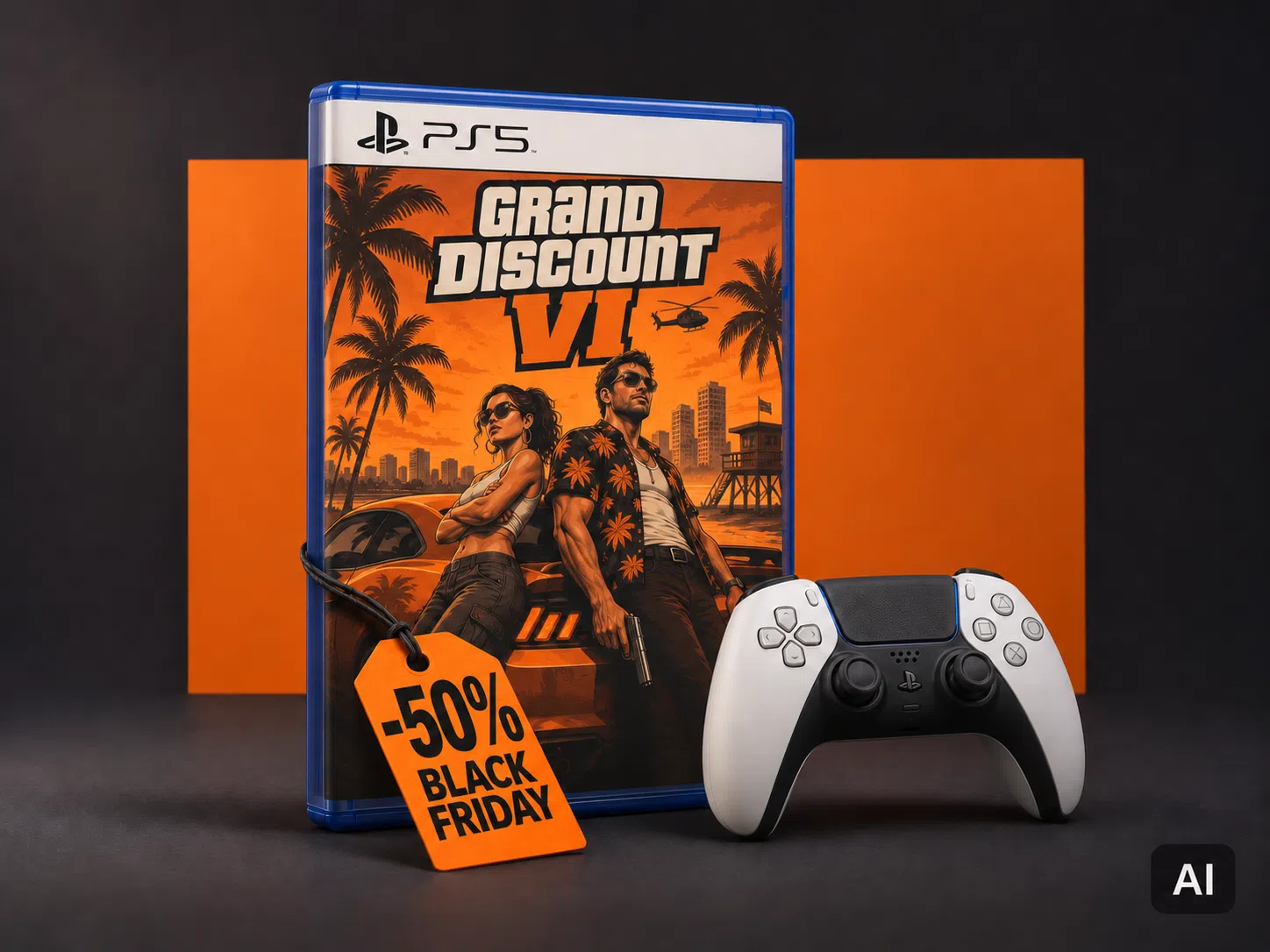
Information checked on 23 November 2026. This guide primarily concerns paid PC games on Steam. The schedule and numerical examples are GamingFox’s own work, not client results or sales forecasts. The cover depicts a fictional game parody; its discount tag is not a commercial offer.
When is Black Friday 2026, and what is happening on Steam?
Black Friday is Friday, 27 November 2026. You will also see retailers refer to Black Week and Cyber Monday. Treat these names as shopping context. Your game’s actual promotion has its own start and end, which should be stated clearly to players.
| Milestone | Date | What to include in your plan |
|---|---|---|
| Monday of Black Week | 23 November | Decide on the objective, discount eligibility and assets. |
| Black Friday presentation on Discounts & Events | 26–30 November, starting and ending at 10:00 Pacific / 19:00 CET | Valve’s published window, not a guarantee of exposure for your game. |
| Black Friday | 27 November | Communicate the studio’s actual offer. |
| Cyber Monday | 30 November | Check end times and stop ads for expired offers. |
| Steam Winter Sale | 17 December 2026–4 January 2027 | Make a separate decision about participation and discount. |
Store dates: Valve documentation [1–2], checked 23 November 2026. The 10:00 Pacific time has been converted to Europe/Warsaw. Studio tasks are GamingFox recommendations.
Valve describes the November activity as additional presentation and promotion of its existing discounts and events page. Do not plan as though setting a discount gives you an agreed homepage placement. Your team still needs its own way to reach players: a community, prepared gameplay, relevant contacts or tested advertising. [1]
This distinction matters when talking to partners too. “Our game will be discounted during Black Friday week” describes a pricing decision. “Steam is promoting us” implies another fact that needs confirmation. Precise communication avoids later explanations and makes the outcome easier to assess.
Should every indie game run a Black Friday discount?
No. Participation depends on the game’s stage, sales history, product readiness and campaign objective. The discount percentage comes next. First establish who you are talking to and why that person should return to your store page now.
A released game: find a specific reason to come back
If your game has an audience but some people postponed buying it, a promotion can give you another opportunity to explain its value. This is especially relevant if something has changed since the previous campaign: improved controls, new content or a fix for a problem the community regularly mentioned. Show that change. “It costs less now” and “It now works the way you need” address different barriers to purchase.
Imagine a co-op survival game with an improved system for joining friends. A clip showing players starting a session together may be more convincing than a graphic containing only a percentage. We are not assuming that message always wins. The recommendation is to investigate what previously held the right players back.
A recent release: a deep discount is not a rescue button
If sales are still taking shape, first examine what happens at the current price. Are people finding the game? Do they understand its genre? Do negative comments concern the product, the price or expectations created by the trailer? Each situation calls for a different response. Lowering the price without diagnosis makes it harder to identify what actually worked.
Collect questions from reviews, comments and discussions. If players expected a sandbox and received a short linear story, improve the description of the experience. If they report technical problems, establish their scale. A discount can bring another group of people to the same obstacle instead of removing it.
No prepared assets: reduce scope while keeping the promise clear
A small team does not need a campaign on every channel. One clear clip, a consistent store page and someone responding to players can be more useful than seven similar graphics published without oversight. If you have not established who the message is for, start by defining your game’s target audience.
Steam discounts: what should you check before scheduling a promotion?
Before approving the campaign, open discount management for the specific game. Public documentation explains the mechanics; the dashboard shows your product’s situation. Check the permissions of the person responsible for saving the discount. Friday is too late to discover that your communications lead cannot change the offer.
Valve normally requires a 30-day cooldown between discounts. Separate restrictions apply after release and after a price increase in any currency. Seasonal sales have an exemption from the discount-to-discount cooldown, but not from release or price-increase restrictions. Black Friday does not receive the seasonal exemption. [3] [1]
A regular November discount does not necessarily exclude the game from the Winter Sale. The seasonal exemption applies to a discount created for the appropriate event in Steamworks. A custom promotion scheduled for similar dates does not automatically receive it. Still check release and price-increase restrictions. [3]
Avoid writing a blanket “Black Friday or December” prohibition into the calendar. Record the promotion type and the reason for any restriction. This helps prevent both abandoning an available opportunity and planning a discount that the dashboard will not allow.
Check the percentage, dates, regional prices and packages. The documentation gives a 10–95% range and a duration of 1–14 days for ordinary discounts; launch discounts have separate rules. These are technical limits, not recommendations to choose an extreme. [3]
When planning two campaigns close together, consider the audience too. If you show the same game to the same community in November and December, what new reason to get in touch will exist a few weeks later? Changing the date on a graphic is not new information. Specify what you will show in each campaign and what you expect it to achieve.
A 50% discount: how many more copies do you need to sell?
At 50% off, you need to sell twice as many copies to maintain the same sales value at purchase prices. This is arithmetic, not a prediction of player behaviour. An increase in copies sold can look good in a report even when sales value falls.
Use a simple model: a regular price of PLN 80 and a baseline of 100 copies, giving PLN 8,000. Compare every scenario with the same target. Round up to a whole copy because you cannot sell a fraction of a licence. We retain the Polish currency from the original example; these are hypothetical amounts, not regional price recommendations.
| Discount | Model price | Copies needed for at least PLN 8,000 | Increase over 100 copies |
|---|---|---|---|
| 0% | PLN 80 | 100 | 0% |
| 20% | PLN 64 | 125 | 25% |
| 30% | PLN 56 | 143 | 43% |
| 50% | PLN 40 | 200 | 100% |
| 60% | PLN 32 | 250 | 150% |
GamingFox simulation. Sales value at purchase prices before taxes, platform share, refunds and campaign costs. This is not the studio’s net revenue. The model does not forecast demand or regional pricing.
0% off: 100 copies → 20% off: 125 → 30% off: 143 → 50% off: 200 → 60% off: 250.
Formula: copies = target divided by discounted price, rounded up. GamingFox simulation, 23 November 2026.
In this example, selling 160 copies at PLN 40 produces PLN 6,400. Unit sales have increased by 60%, while sales value has fallen by 20% against the baseline. The campaign may still meet another objective, such as reaching new players, but it should not be described as growth in sales value.
Separate sales value from the money remaining with the studio
A business decision needs your own settlement data. Account for taxes, refunds, platform share, your publishing agreement and campaign costs. We are not applying a universal “price times a fixed percentage” conversion because project terms and the composition of purchases can differ.
As a separate calculation only, suppose an additional copy leaves PLN 20 available to cover the campaign and contribute to the result. If the campaign costs PLN 1,200, you need 60 additional copies to cover that expense. This does not mean all sales during the promotion. Some purchases might have happened without the advertising or discount.
Without a comparison or experiment, you cannot precisely establish that incrementality. You can still make the uncertainty visible: report the total result, costs, sales attributed to sources and limits on what you can conclude. Our indie game marketing budget guide explains how to plan the full cost.
What should a Black Friday campaign show beyond the percentage?
A player needs to understand what they are buying before deciding whether the price is attractive. Choose one situation that communicates the game’s promise. In a strategy game, it might be getting an economy running smoothly; in horror, recognising a threat; in co-op, solving a problem together. Add the offer terms to that experience.
Make the message understandable without prior brand knowledge
“Black Friday, 30% off” gives a new viewer very little information about the game. A more useful structure is a short description of the experience, evidence in gameplay and the discount deadline. For example: “Build an underground colony where every tunnel changes the airflow. See the new ventilation system. Discounted until Monday, 19:00 CET.” This is fictional sample copy, not an offer for a real game.
For your existing community, you can begin with what has changed since the last update. For a new audience, begin with the game itself. The two groups do not need identical introductions even when they land on the same store page.
Check the Steam page after clicking the ad
The promise in the asset should continue on the store page. If you promote co-op gameplay, players should quickly find the conditions for playing together. If you show an update, make its availability clear. Avoid driving traffic to a page that looks like a record of an older version of the project.
Check the first assets, short description, supported languages, requirements and current announcements. Do not rebuild everything immediately before a campaign without a reason. Choose changes that resolve actual confusion. Comparing the page with questions from people outside the team can help.
Keep promotional text off the base capsule artwork
Valve does not permit discount advertising or purchase calls to action in base graphical capsules. The rules for these assets differ from what you can put in your own social post. A Facebook visual is therefore not automatically a suitable replacement for your Steam capsule. [4]
Keep store assets, posts, ads and event graphics separate. Label their intended use in your folders so that nobody submits the wrong version. Check dates, language and currency on every sales asset. A price from the Polish version may not be appropriate for English-speaking players in other countries.
Black Week 2026: a plan from Monday to Cyber Monday
The following schedule is a proposal for a small studio organising its campaign from 23 November. It does not assume that the whole team works on marketing. Each stage focuses on one outcome that helps establish whether the next task makes sense.
- 23 November: objective, economics and discount eligibility.
- 24–25 November: gameplay, store page and tagged links.
- 26 November: check the start and the actual offer.
- 27–30 November: respond to players and control costs.
- After the promotion: close the offer and complete measurement.
GamingFox’s own plan. The 10:00 Pacific / 19:00 CET time refers to the Discounts & Events presentation, not every developer promotion.
Monday: one decision and a short spreadsheet
Write down the objective, proposed discount, dates and maximum spend. Check eligibility and how the plan relates to December’s sale. Assign a person to approve the price and a person responsible for publishing. If they are the same person, account for their availability.
Add a baseline: sales and traffic from a comparable earlier period, plus information about updates or other activity. This does not create a control group, but it helps avoid comparing the promotion weekend with an arbitrarily weak day earlier in the month.
Tuesday and Wednesday: assets, the page and relevant contacts
Prepare the clip, main message, language versions and tagged links. Watch the asset without sound and on a phone. Make sure it shows the experience rather than just the studio intro. Plan answers to common questions and a process for technical issues.
If you contact creators, choose people whose content fits the genre and account for the short lead time. Explain what is interesting about the game and useful for the channel’s audience. A discount does not replace a reason to make a video. Do not base the week’s expected result on unconfirmed coverage. Our guide to working with gaming influencers covers partner selection.
Thursday: verify the launch
Check the actual store price and end time once your own promotion starts. Open the link from the finished post, not just the spreadsheet. Verify that it leads to the correct product and does not advertise an expired offer. If your campaign starts later than Steam’s presentation, communicate the studio’s actual dates rather than automatically saying Thursday.
Friday and the weekend: respond instead of repeating the graphic
Monitor questions and problems. If people regularly ask about local co-op while the game offers online play only, explain that somewhere visible. If editions are confusing, help players compare their contents. These answers may be more useful than another “remember our sale” post.
For paid campaigns, define a condition for stopping spend in advance. It could be no measurable purchases after reaching an agreed limit, a broken landing page or a technical issue in the game. “Spend the whole budget by Monday” is not a useful objective if the results do not justify continuing.
Monday and afterwards: close the offer and record decisions
Once the promotion ends, stop assets with outdated prices and check scheduled posts. Split reporting into an initial reading and a later update for conversions and refunds. Record what you will change before the Winter Sale: the offer, assets, audience or measurement. A results table will not make that decision for the team.
Black Friday before release: promote without promising a discount
If the game is not on sale yet, choose an objective appropriate to its stage: wishlisting, trying a demo or discovering the project. Do not describe adding a game to a wishlist as buying it at a discount. You do not need to announce a price that the team has not approved.
Show new gameplay, answer questions from tests or invite people to an existing demo. Distinguish clearly between a free demo and the full game. If the demo is still in development, do not chase Black Friday at the expense of the first experience.
In this scenario, measure interest from relevant people: where store visitors come from, whether they wishlist and what they say after playing. Do not directly compare those outcomes with sales of a released game. Our guide explains how to grow Steam wishlists.
How do you know whether a Black Friday campaign paid off?
Your report should separate three questions: what sold in the store, what was attributed to specific sources and what the studio spent. The answers need not produce the same number. A difference is not automatically a tool error because the measurement scopes differ.
Wishlist notifications: check the conditions
According to Valve, a discount of at least 20% can trigger notifications for people with the game on their wishlist. It must include the lowest-priced package and run for more than eight hours. Notifications have their own limits and cooldown, so do not promise that every player will receive one at the instant the discount starts. [5]
This is an information distribution feature, not evidence that 20% is the best discount for every project. Pricing should still account for the objective, product history and economics. Meeting a technical threshold does not guarantee a purchase.
Tag sources and give the data time
Use separate UTM parameters for channels and assets in Steamworks. You could use utm_campaign=black_friday_2026 and put the specific platform or creator in utm_source. Identify the clip variant with utm_content. Keep names consistent so that one publication does not appear under several accidental labels.
Valve distinguishes Total Visits, Trusted Visits after filtering some automated traffic, and Tracked Visits from signed-in users. Attributed conversions use a 72-hour window; conversion data is finalised four days after the visit. A reading immediately after the campaign ends is therefore incomplete. [6]
Do not attribute the whole sales increase to one post. Store recommendations, other coverage and purchases by people who already knew the game run alongside it. Additional page traffic alone is not a visibility factor on Steam, as Valve explains. [7]
Record dates, copies, sales value, refunds, available settlement results, external costs and team labour. Include UTM outcomes and other activity during the period. If you do not measure something, label the gap. An honest report with missing data is more useful than a complete-looking report filled with guesses.
Mistakes to avoid this week
Choosing the percentage before the objective. The whole team can end up working on an offer without anyone knowing what result would justify its cost. Begin with the change you want to achieve.
Preparing only a “cheaper now” message. Someone unfamiliar with the game still does not know whether it is for them. Show the experience, then the promotion terms.
Confusing Black Friday with a seasonal sale. Valve distinguishes these mechanisms this year. Check the calendar and discount dashboard before promising a date.
Reporting more copies as growth in sales value. With a lower price, these metrics can move in opposite directions. Your conclusion should match the actual number and its definition.
Repeating the same campaign in December. Leave room for new gameplay or another message. If nothing has changed, consider whether the next contact is useful to the audience.
FAQ: Black Friday 2026 for game developers
When is Black Friday 2026?
Friday, 27 November. Cyber Monday falls on 30 November. Give exact dates and times for your own game’s offer because it does not have to last the whole week.
What time does Steam’s Black Friday activity start?
The Discounts & Events presentation is scheduled from 26 November at 10:00 Pacific / 19:00 CET to 30 November at the same time. This is the window for Valve’s promotional page, not a shared start time for every discount. [1]
Should an indie game be 50% off?
There is no universal answer. At that discount you need twice as many copies to maintain the same sales value before further deductions and costs. Check the product stage, sales history and objective.
Can a game join the Steam Winter Sale after Black Friday?
A November discount does not necessarily prevent it because of the seasonal exemption. Check release and price-increase restrictions separately and select the correct event in the dashboard. [3]
Does a discount automatically improve game visibility?
Do not treat it as guaranteed exposure. Combine pricing, relevant audiences, a clear store page and measurement. Page traffic alone does not trigger a simple increase in visibility. [7]
What if the game has not been released?
Show the playable experience and direct people to an action available now: a wishlist or demo. Do not invent an offer or imply that a wishlist addition is a purchase.
Start with a decision you can explain
This week needs a consistent answer: who you are inviting, what you are showing, what the offer is and how you will judge its result. If you can write that in a few sentences, preparing assets and dividing the work becomes easier. If you cannot, another percentage graphic probably will not solve it.
At GamingFox, we help structure game marketing strategy and improve Steam store pages. We can start by reviewing what you already have and priorities for the next stage, without assuming every game needs the same discount or campaign.
Let’s discuss your game’s promotion
Sources and methodology
Documentation checked on 23 November 2026. Dates and platform rules come from Valve. Calculations, recommendations and the weekly plan are our own. We have not used private studio data, forecast sales growth or measured keyword search volumes.
- Valve: Upcoming Steam Events. Black Friday presentation, 26–30 November; ordinary cooldown.
- Valve: Seasonal Sales. Winter Sale 2026 dates.
- Valve: Discounting. Cooldowns, exemptions, thresholds and duration. Check your own game’s current dashboard before implementation.
- Valve: Graphical Asset Rules. Base capsule artwork rules.
- Valve: Wishlists. Discount notification conditions.
- Valve: UTM Analytics. Measurement scope and attribution limitations.
- Valve: Visibility on Steam. Store page traffic and visibility.
The PLN 80 price and PLN 8,000 target simulation is not a benchmark. It omits regional pricing, taxes, platform settlements, refunds and campaign costs. The second example assumes a hypothetical PLN 20 remaining from each additional copy. The numerical summary uses the same data as the table. The AI-generated cover depicts a fictional “Grand Discount VI” case and does not announce a product or discount.