
You have PLN 15,000 to market your game. You could commission a trailer, run ads, pay a few creators or maintain regular communication for a couple of months. Any of those choices could make sense. Any could also leave you holding an invoice and asking: “All right, but where are the players?”
How much does indie game marketing cost? It depends on what you already have, whom you need to convince and which stage of promotion you are funding. Instead of offering one universal number, this guide explains how to build a budget, test its assumptions and decide when to spend more. We draw on SteamDB data, Valve’s documentation and publicly reported campaigns for named games.
Scope: premium PC games promoted before launch on Steam. Sources checked on 12 November 2026. Historical data retains its original date and scope. All simulations are labelled; the examples are not GamingFox client results. Example budgets remain in Polish złoty (PLN) to preserve the original assumptions.
1. Why plan your game marketing budget before launch?
Imagine launching without much of a campaign. The game appears in the store, you publish a post, send a dozen messages and refresh Steamworks. Other developers are doing exactly the same thing. Merely releasing a game does not explain why a player should choose yours.
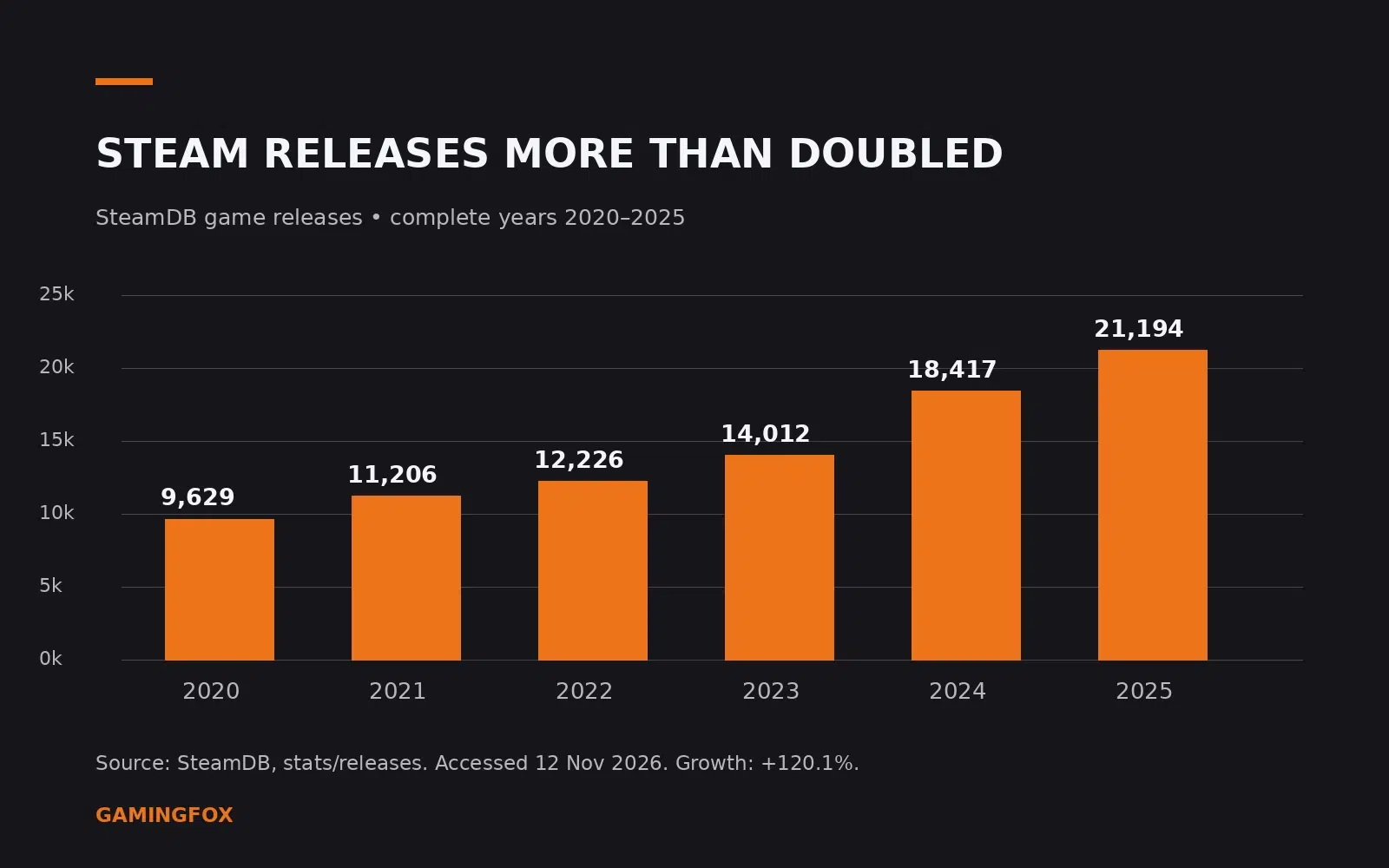
SteamDB lists 9,629 game releases in 2020 and 21,194 in 2025, an increase of approximately 120% calculated from those two values. The 2025 total averages roughly 58 releases per day. These figures cover all games in the dataset, not only commercial indie releases. [1]
This does not mean your game needs twice the marketing budget it would have needed a few years ago. It means you should be precise about whom you are addressing. Someone looking for their next city builder may have little interest in a short horror game, even if both carry an “indie” label.
More traffic does not automatically mean more visibility
Valve explains that traffic to a store page is not itself a factor that increases store visibility. Extra visits may generate sales, which do matter, but buying visits does not activate a simple “more clicks, more recommendations” mechanism. Wishlists are also not a direct factor in algorithmic visibility, apart from exceptions such as Popular Upcoming. [2]
“Bring in as many people as possible” is therefore too vague a goal. You need people who understand the game’s promise and want that experience. Start with our guide to defining your game’s target audience.
You cannot buy an ad on the Steam homepage
Steam does not sell paid advertising placements inside its store. Social media and search campaigns can send people to a Steam page, but they do not buy a position in Valve’s recommendations. If a proposal includes “Steam ads”, clarify exactly where the advertisements will appear. [3]
2. What does indie game marketing actually cost?
Advertising spend is easy to notice because the dashboard shows the amount. Recording footage, writing a description, talking to creators and refining campaigns are less visible costs. Yet these activities determine where an ad leads and what it promises.
We recommend tracking two separate figures: cash expenditure and the full cost of labour and promotion. The first tells you how much money you need in the bank. The second shows how many resources the project actually consumes.
| Area | What it covers | What to ask before requesting a quote |
|---|---|---|
| Strategy and positioning | Audience analysis, comparable games, differentiation, objectives and action plan | Is this a plan for our game or a list of generic ideas? |
| Steam store page | Description, tags, screenshot selection, capsule and trailer recommendations | Does the price include implementation, translation and design work? |
| Assets | Gameplay capture, editing, graphics, ad variants and subtitles | How many formats, languages and revision rounds are included? |
| Reaching players | Media spend, paid creator placements and any paid tools | How much funds distribution and how much pays for management? |
| PR and creator outreach | Contact research, tailored messages, press kit and follow-ups | Are we paying for outreach work or a contracted publication? |
| Community and social media | Content planning, posting, replies, moderation and feedback | Who answers players, and during which hours? |
| Measurement and optimisation | UTM tracking, reporting, test interpretation and next steps | How will the findings change the next spending decision? |
| Contingency | Extra asset variants, revisions and schedule changes | Who can release this allocation, and on what basis? |
Doing it yourself also has a cost
As a purely illustrative example, suppose you spend eight hours a week on promotion for eight weeks. That is 64 hours. At an internal planning value of PLN 100 per hour, it represents PLN 6,400 of in-house work. This is neither a market rate nor a salary recommendation. It helps test whether “free marketing” fits your team’s capacity.
With PLN 5,000 of cash spending, that phase consumes resources valued at PLN 11,400 in total. You do not have to pay yourself the difference, but you do have to find 64 hours that cannot also go into programming, QA and tutorial improvements.
This is especially important in a small studio. Someone recording a trailer is not simultaneously fixing a save-system bug. On paper, both tasks can be due on Friday. In practice, Friday still has only one evening.
Separate publishing costs from promotion costs
The Steam Direct fee is US$100 or the equivalent per app, with applicable taxes. It is recoupable after the app reaches at least US$1,000 in Adjusted Gross Revenue under Valve’s stated conditions. This is a distribution entry cost, not an advertising budget. [4]
Treat demo production, testing, full-game localisation and technical launch support similarly. Marketing planning should account for their deadlines and dependencies, but grouping everything under “promotion” makes spending harder to evaluate.
3. How does your game’s genre affect the budget and channels?
The same amount of money can fund very different activities. Before comparing campaign prices, establish what a player must see to think, “This is for me.” The following are strategic recommendations, not a statistical ranking of channel effectiveness.
Horror: show a specific situation and emotion
If your game’s strength is the tension of listening for an enemy, a beautiful corridor may not communicate it. You need footage showing a player’s decision and its consequences. The budget may need to cover good capture, sound editing and contact with creators whose audiences enjoy that experience. It may not need a lengthy animation explaining the world’s history.
Strategy and management: sell decisions and their consequences
For a colony management game, players may want to understand what they optimise, how the settlement develops and how it differs from games they already know. Allow time for clear footage of the gameplay loop, explanations of systems and material for strategy-focused channels. A short clip should give people a reason to watch more.
Co-op: show what happens between players
Solo footage may miss the best part of a game if its most interesting moments involve three people trying to escape a disaster together. Budget for multiplayer recording sessions, connection tests and creator logistics. Campaign reach is of little help if the invited team cannot join a session.
Cozy games and simulators: show the activity worth returning to
Transforming a room, opening a workshop, harvesting crops and organising a warehouse offer different promises. Instead of building a campaign around the broad label “a relaxing indie game”, test several ways to show what players actually do. Even calm footage needs something concrete.
What does this change in the budget? First identify the evidence your audience needs. Then price the work needed to create it and reach the relevant niche. This is one reason specialisation in game marketing matters: the store page, demo, gameplay format and discovery process need to work together.
4. Example game marketing budgets: PLN 5,000, 15,000 and 50,000
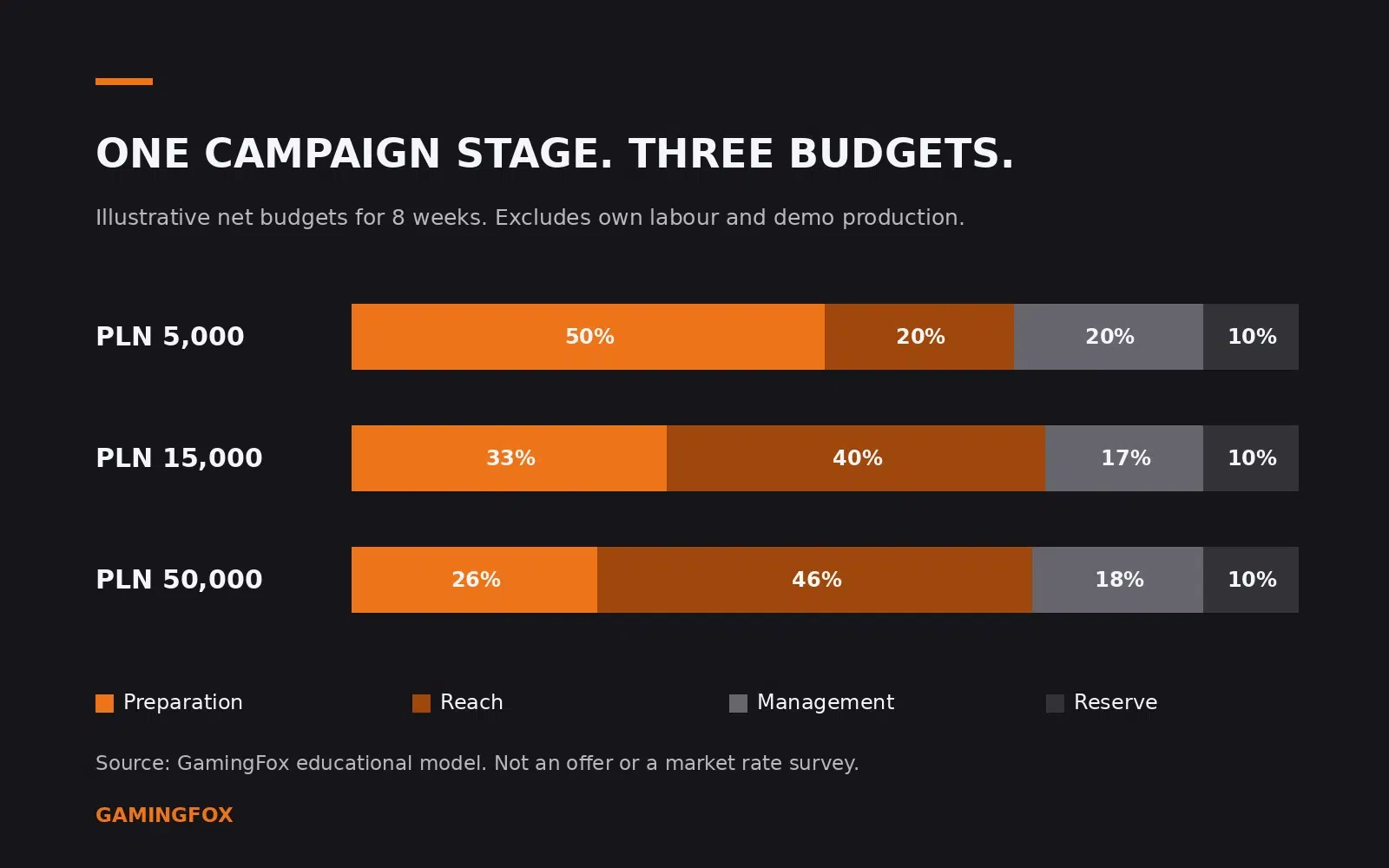
To make the comparison meaningful, all three scenarios cover the same period: eight weeks before a major campaign milestone, such as a demo release. They are not estimates for the game’s entire lifecycle or promises of eight weeks of agency service at a fixed price.
We assume the studio already has a playable build, gameplay material and basic branding. The budgets exclude demo production, a complete trailer made from scratch, full-game localisation, Steam Direct and in-house labour. PLN amounts are net planning allocations: add non-recoverable VAT, fees and potential currency differences before committing to spending.
| Item | PLN 5,000 | PLN 15,000 | PLN 50,000 |
|---|---|---|---|
| Strategy and audience research | 1,000 | 2,000 | 5,000 |
| Steam page and asset adaptation | 1,500 | 3,000 | 8,000 |
| Media spend | 1,000 | 4,000 | 15,000 |
| Creator fees | 0 | 2,000 | 8,000 |
| Management, outreach and reporting | 1,000 | 2,500 | 9,000 |
| Contingency | 500 | 1,500 | 5,000 |
| Total | 5,000 | 15,000 | 50,000 |
Original GamingFox simulations. Individual amounts are spending limits within a model, not verified supplier rates. Adjust the scope to actual quotes.
PLN 5,000: strengthen the basics and run one focused test
Scope discipline matters most here. PLN 1,000 for management cannot simultaneously fund regular social media, Discord moderation, dozens of personalised contacts and two months of advertising management. The studio must handle a substantial share of the work.
A practical objective is to refine the game’s presentation, improve the store page and test one traffic source with several creative variants. A PLN 1,500 asset allocation may mean adapting existing material. If you need new capsule artwork and extensive editing, request a quote and revise the split.
If essential assets are missing, putting the entire budget into preparation and audience testing may be the better choice, with no paid distribution yet. Reallocating money is part of planning. You do not have to spend PLN 1,000 on ads simply because the table has a row for them.
PLN 15,000: a first campaign with room for comparisons
This scenario allows more than a single trial: different messages, a separate small paid-creator test and time to analyse results. Priorities still matter. PLN 2,000 for creators does not imply a predetermined number of videos, because prices and deliverables depend on the channel and format.
For a management game, you might compare two assets: one showing a business expanding and another showing a difficult economic decision. Show them to comparable audiences and assess interest in the store page and wishlists. The result should help choose the next direction for communication.
Do not let the entire media budget disappear in the first few days. Reserve part of it for a variant that deserves a further test after initial analysis. Launching a campaign is not, by itself, an argument for continuing it.
PLN 50,000: more scale and more accountability
A larger allocation creates room for stronger preparation, several formats, creator coordination and activity in more than one market. It does not make every channel worthwhile. If the initial assets explain the game poorly, more spending may simply deliver the same problem to more people faster.
At this level, we would expect a phased plan, clear responsibilities, decision-focused reports and a rationale for each further spending tranche. If the studio also needs a trailer, key art and an extensive demo made from scratch, PLN 50,000 still requires firm choices about scope.
How do you choose a budget for your game?
Ask three questions: what needs to be ready before traffic increases, what do you still need to learn about players, and how much can you spend finding out? A test budget is useful when its findings change the next step. A campaign after which you will do exactly the same thing regardless of the result is a weak test.
5. How much does a Steam wishlist cost? What real data shows
There is no universal price for a Steam wishlist. Cost depends on the traffic source, creative, genre, market and measurement method. Before comparing two results, check exactly what sits in the numerator and denominator.
Case study: This Grand Life 2
Patrick Tang of Poking Water Games described a campaign for the economic life sim This Grand Life 2. In a May 2024 account, he reported US$4,365 spent and approximately 4,000 wishlists acquired. The reported average cost was around US$1.10, with individual ad groups ranging from US$0.80 to US$2.50. The campaign mainly used Reddit, with tests on other platforms. [5]
This is a useful reference because it identifies the game, period and budget. It is not a Steam-wide average. The developer was pursuing a particular visibility outcome, so the result should not be treated as proof of profitable sales.
The useful budgeting lesson is simpler than copying the rate: even within one game, ad groups produced different costs. Analyse your own results separately instead of hiding weaker activities behind a single average.
A benchmark of 105 creator campaigns: read the methodology
In a report dated 4 November 2026, Trapster stated a median cost of US$0.49 across 105 completed short-form creator campaigns. One quarter came in below US$0.17 and one quarter above US$1.41. These are a service provider’s data from its own campaigns, not a random sample of the whole market. [6]
A crucial methodological detail: the company divides creator payouts, excluding its platform fee, by half the observed wishlist growth from the campaign’s start to 14 days after its end. Growth is estimated from public data. This is not the same method as counting UTM-attributed conversions in Steamworks. Assigning half of the growth is a model assumption, not experimental proof of campaign impact.
Do not automatically compare US$0.49 with US$1.10 and conclude that one service is twice as effective. The games, periods, cost scopes and attribution methods differ. These distinctions should be explicit when discussing a quote.
Media-only CPW and fully loaded CPW are different numbers
CPW, or cost per wishlist, measures spending per wishlist addition. Two versions are useful when managing a campaign:
- Media-only CPW: advertising spend divided by wishlists attributed to those ads under a specified measurement method.
- Fully loaded CPW: media, assets, management and agreed in-house labour costs divided by the result attributed to that same overall scope of activity.
For example, PLN 4,000 in ad spend and 800 attributed wishlists produces a media-only CPW of PLN 5. If assets and management cost another PLN 4,000, fully loaded CPW is PLN 10. The campaign result has not changed. The difference is which acquisition costs you include.
If an asset will be used across several phases, you can allocate its cost between them. Agree on the method before reporting and apply it consistently. Otherwise, each new report can look better simply because inconvenient costs disappeared from the spreadsheet.
6. How do you assess whether a game marketing budget makes sense?
The cheapest wishlist is not always the most valuable. A player might wishlist a game and never buy it, or buy only during a sale. Do not base further spending decisions solely on CPW.
First, distinguish two meanings of wishlist conversion
One metric measures how many people who wishlisted the game actually bought it. Another divides all copies sold by the number of pre-launch wishlists. In the second metric, the numerator also includes purchases from people who never wishlisted the game.
In an October 2025 analysis, GameDiscoverCo reported a median first-week sales-to-launch-wishlists ratio of approximately 0.10 for an analysed subgroup of games with over 25,000 wishlists and a launch price above US$10. These are external estimates for a selected group, not a universal rate. Crucially, they include all first-week sales, not only purchases by wishlist users. [7]
You cannot turn that into a promise that 10% of the people acquired by your campaign will buy. Estimating the value of wishlists from a specific source requires assumptions about those players and the chosen period. A broad median can inform a discussion of risk, but cannot replace project data.
A simple model: how much can you spend per wishlist?
For this model, let M be the amount left to the studio from one additional copy to cover promotion and fixed costs, after platform deductions, indirect taxes, refunds, agreed partner shares and variable costs. It is neither the Steam store price nor the company’s net profit.
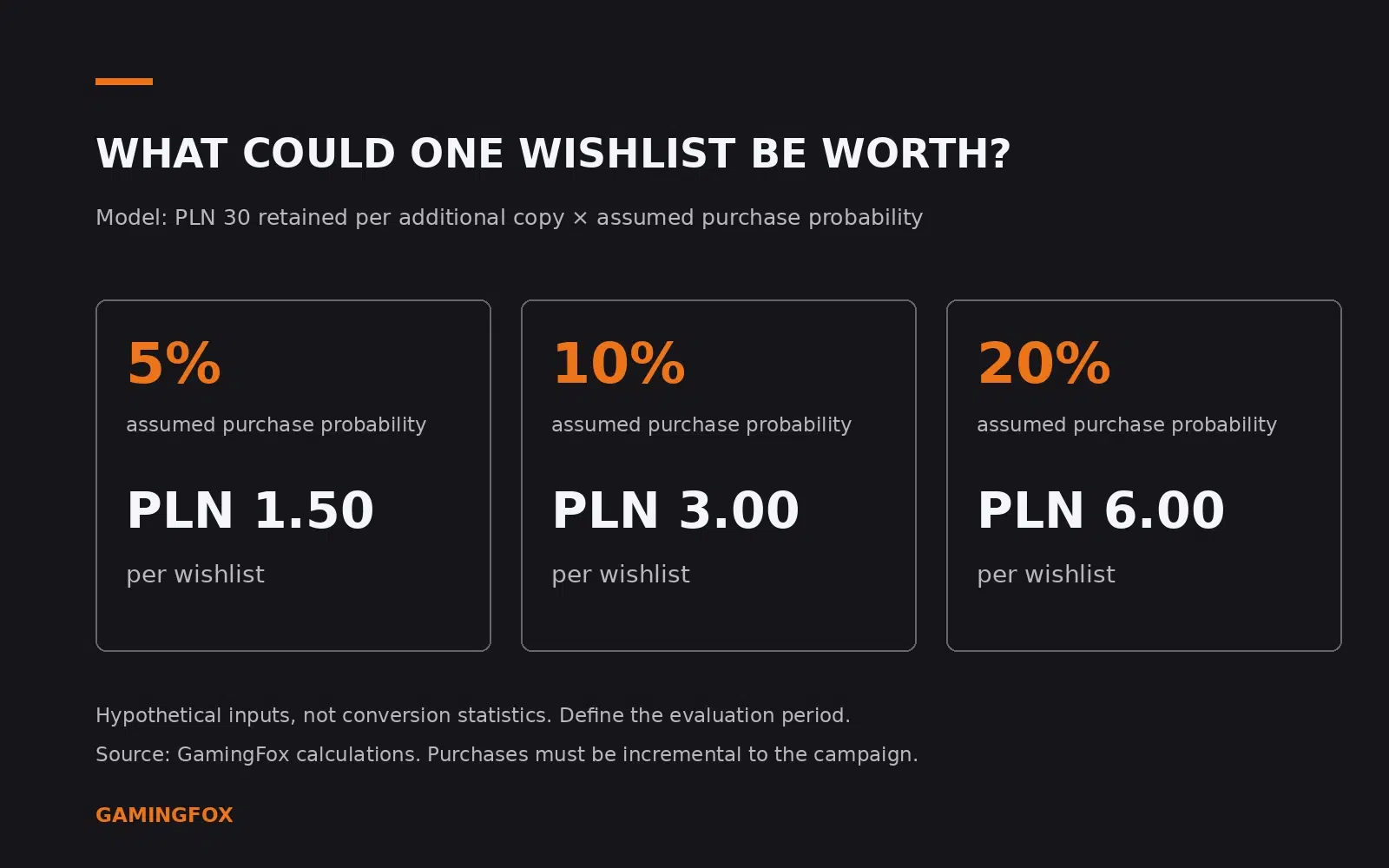
Modelled wishlist value = M × assumed probability of an additional purchase within the chosen period. This is a simplification. It assumes that the purchase happens because of the activity being evaluated. If some people would have bought without the campaign, the true incremental value is lower.
For this exercise, assume M = PLN 30. Three hypothetical purchase probabilities give the following results:
| Model assumption | Calculation | Value per wishlist |
|---|---|---|
| 5% buy within the chosen period | PLN 30 × 0.05 | PLN 1.50 |
| 10% buy | PLN 30 × 0.10 | PLN 3.00 |
| 20% buy | PLN 30 × 0.20 | PLN 6.00 |
The 5%, 10% and 20% figures are simulation assumptions, not forecasts from GameDiscoverCo’s research. The model excludes later purchases, DLC and referrals. Do not assign value to these without evidence.
If your model values a wishlist at PLN 3 while its fully loaded acquisition cost is PLN 8, you need a reason for the difference. That might be evidence of longer-term sales, another campaign objective or an indirect effect being tested cautiously. “Steam will boost it after launch” is not a calculation.
Calculate the additional copies needed to cover a campaign
A second simple calculation is campaign cost ÷ M = additional copies required to cover the campaign. At a cost of PLN 15,000 and M of PLN 30, you need 500 additional copies. That covers this campaign, not the entire development budget.
The word “additional” matters. Selling 500 copies during the campaign does not prove profitability if some would have sold anyway. Consider a baseline, comparable periods, other activities and uncertainty. Even an imperfect model is more useful than assuming every sale belongs to the most recently launched ad.
7. How to measure game marketing in Steamworks
A report should answer “what do we change?”, not just “what happened?”. For a pre-launch campaign, use a shared view of spending, traffic sources, attributed wishlists and total wishlist growth. Each tells you something different.
Agree on UTM naming before the first post
An example link for a paid Reddit clip might look like this. Replace APP_ID with your game’s identifier:
https://store.steampowered.com/app/APP_ID/?utm_source=reddit&utm_medium=paid_social&utm_campaign=demo_test&utm_content=gameplay_aUse a consistent convention: source identifies where the visitor came from, medium distinguishes the type of activity, campaign names the phase, and content identifies the asset. For the second creative, change gameplay_a to gameplay_b. Do not include a recipient’s name or other personal data.
Check exactly what Valve reports
Steamworks distinguishes Total Visits, Trusted Visits and Tracked Visits. Tracked Visits are those where a logged-in user could be identified; conversions are reported for tracked traffic. The attribution window is 72 hours, and conversion data is finalised four days after the visit. Switching browsers or independently searching for the game can break attribution. Some transitions into the Steam client or app through Steam mechanisms can preserve it. [8]
Call UTM-based CPW the cost of an attributed wishlist. It is not a complete measurement of every advertising effect. Equally, do not assign all unattributed growth to the campaign. A tracking gap does not prove that every extra wishlist came from ads.
Demo statistics are not a ready-made UTM report for the base game either. Valve states that demo downloads are not counted as these conversions from a link to the base game. Assess them separately and combine the findings cautiously. [8]
A minimum report that supports decisions
| Area | What to record | Decision it supports |
|---|---|---|
| Costs | Media, assets, management and in-house labour | Can we afford to continue, and what is the full cost? |
| Creative and audience | Clip version, message, market, language and source | What should we repeat or change? |
| Steam UTM | Visit types and attributed wishlists, with the reporting date | Which variants deliver measurable results under the same method? |
| Whole project | Daily wishlist growth and a log of other activities | Is there broader growth that should not automatically be assigned to one campaign? |
| Player feedback | Questions, misunderstandings and demo reactions | Does the communication promise the right experience? |
Record the dates of capsule changes, trailer releases, creator videos, festivals and ad launches. If everything happens on one day, the growth may be good for the game, but separating the contribution of each activity becomes harder.
Do not declare a winner after a handful of wishlists
Variant A receives 100 comparable visits and 10 attributed wishlists. Variant B receives 100 visits and 12 wishlists. B has a higher observed result, but such a small difference in such a small sample may be random. Treat it as a reason to keep testing, not a new formula for game marketing.
Before the test, define the question, spending cap, evaluation date and stop conditions. Stop early if a link is broken, the campaign reaches the wrong market or the build has a problem. If there is too little data, reporting two decimal places does not solve it.
8. How should you phase your marketing spending?
Allocating amounts is only part of the job. You also need a sequence. Paying for a creator publication before the store page is ready, or just after a demo becomes unavailable, can undermine the entire activity.
Stage one: prepare the destination
Review the Steam page, the game’s distinguishing feature, visual evidence of gameplay and the clarity of the description. Players should understand what they do, why it is interesting and what to expect. Our guide to growing Steam wishlists covers these elements in more detail.
Valve requires a new game’s Coming Soon page to be public for at least two weeks before release. That is an administrative minimum, not a recommended duration for the entire campaign. The documentation recommends publishing the page when you are ready to talk publicly about the game. [9]
Stage two: test the message on a smaller scale
In the eight-week model, the first two weeks could cover preparation, the next two initial tests, and the following two revisions and expansion of promising activities. Reserve the final two weeks for the campaign milestone and analysis. This is an example work schedule, not a platform rule.
Do not split a small budget across six channels just to “be everywhere”. You may end up with six tiny samples, none of which provides a useful answer. Choose the question that matters most: the audience, the promise or the format.
Stage three: plan the demo and event together
Steam Next Fest requires an unreleased game and a publicly playable demo, and a title can participate in only one edition. Choosing the event therefore affects production, assets and promotion. Account for build review and the deadlines of that particular edition. [10]
Include demo communication, creator materials and response analysis in the marketing budget. Put build preparation, QA and fixes in the production budget. Both lists need a shared readiness date. Do not direct attention towards a build the team itself is not ready to show.
Stage four: keep resources for after launch
Answering questions, communicating updates, correcting assets and finding new audiences do not stop on release day. For a longer plan, budget separately for pre-launch, the launch window and post-launch work. Do not fund all three from money already spent preparing the demo.
Treat contingency as money for a specific need. Another asset can make sense after you discover a better way to show a mechanic. Spending the remainder simply to use up the budget does not help the game.
9. What should you do in-house and what should a game marketing agency handle?
Start by identifying the missing decision or capability. Some studios capture excellent gameplay but need a strategy for reaching people. Others know their audience but lack time to coordinate a campaign. The same package of services will not be equally useful to both.
What should stay close to the development team?
Keep game knowledge, update plans, build access and quick answers to technical questions close to the developers. An agency can prepare communication, but it needs accurate information about production. If multiplayer is not ready, it should not become the promise of the next campaign just because it sounds good in an ad.
The studio should also appoint someone to approve assets and make decisions. Waiting a week for an answer to “is this gameplay footage still current?” can cost more than another hour of editing.
Where does GamingFox’s specialisation help?
At GamingFox, we specialise in game marketing. We start campaign planning with the relationship between a game, its audience and how it is presented. On Steam, that means connecting positioning, the store page, assets, creator outreach and measurement into one strategy.
Suppose you need to decide whether to increase ad spend. The campaign dashboard alone will not tell you whether the capsule suggests the wrong genre, the trailer omits the best mechanic, or creators receive a build that is difficult to showcase. Evaluating game promotion requires looking there too.
You can commission a specific area, such as an audit and strategy or Steam store page optimisation, while handling other work internally. Broader support makes sense when its scope fits the project’s needs and production capacity.
How do you compare two game marketing proposals?
- Compare the same period, objectives, markets and asset scope.
- Separate management fees from ad spend and creator payments.
- Check who supplies gameplay footage, translations and format adaptations.
- Distinguish a contracted publication from an attempt to secure coverage.
- Ask how wishlists and costs are attributed.
- Check how much studio time the collaboration requires.
- Agree on access to accounts, materials and reports after the phase ends.
If you are considering funding and publishing support, also read our comparison of self-publishing and working with a publisher. That is a different decision from commissioning an individual campaign.
10. Mistakes that undermine a marketing budget
Using a percentage of development spending without checking needs
A rule such as “spend a certain percentage on marketing” can start a conversation. It does not tell you whether assets are ready, whether localisation is needed or how much time remains before launch. Build the estimate from specific tasks, then check whether the project can afford them.
Comparing reach instead of audience fit
A million views does not tell you how many viewers want this kind of game. Creator partnerships also depend on audience fit, format and the opportunity to show gameplay. Our guide to promoting a game with influencers explains how to choose partners.
Attributing all wishlist growth to advertising
If a festival, creator video and advertising campaign run in the same week, all may contribute. Saying “we spent PLN 2,000 and gained 1,000 wishlists, so CPW was PLN 2” needs a qualification: it describes total growth during the period, not the confirmed result of the ads alone.
Underinvesting in a clear explanation of the game
If viewers cannot explain what they do in the game after watching a clip, another targeting variant may not solve the problem. First test the material with people familiar with the genre. Ask them to describe the gameplay they expect in their own words. Their answers show whether the message is working as intended.
Spending more to rescue an unready milestone
Delaying a campaign can be sensible if the build is broken, an important asset is outdated or the team cannot support the event. Check commitments and deadlines in each case. More media spend will not fix a bug that prevents people from launching the demo.
11. FAQ: Steam marketing budgets and game promotion
How much money do you need to market your first indie game?
There is no single amount that suits every first game. Begin by costing missing assets, Steam page work, one audience-reach test and team time. The PLN 5,000, 15,000 and 50,000 examples in this guide cover one phase, not a complete launch.
Can you promote a game without an advertising budget?
Yes. You can improve the store page, share gameplay, contact relevant creators and participate in suitable events. You still need time, materials and a game ready to show. No media spend does not mean no promotion costs.
Is PLN 5,000 enough for a game launch?
Do not assume it will cover an entire launch. In our model, it funds a narrow preparation and testing phase with substantial studio involvement. If the trailer, capsule and basic communication are missing, reduce the scope or increase the allocation.
What is a good cost per wishlist?
A good CPW fits your game’s economics and a clearly defined measurement method. Compare the same cost and result scopes. Set your own limit using cautious assumptions about additional purchases and the amount remaining per copy, rather than copying one benchmark.
Which matters more: a trailer or advertising?
It depends on the current bottleneck. If the assets do not explain the gameplay, improve them first. If the page and message are clear but the game is not reaching suitable players, a distribution test can provide a useful answer. Ad spend does not replace assets.
Should an agency guarantee wishlists or sales?
Ask exactly what the claim includes and how it will be verified. Work scope, deadlines and contracted publications can be defined precisely. Forecast wishlists and sales require assumptions, scenarios and an explanation of risk. They are not the same as guaranteed activities.
Does this guide also cover mobile and free-to-play games?
Not directly. This guide covers premium PC games before launch on Steam. Mobile and free-to-play require different models, including installation, retention and monetisation analysis. Treating cost per wishlist as equivalent to cost per install would be misleading.
12. How do you start planning your game’s budget?
Before commissioning a campaign, prepare a short project brief. Include the Steam link, gameplay loop, comparable games, production stage, languages, planned milestone, available assets, previous activity and spending limit. Identify who in the studio can work on marketing regularly.
Then choose one decision for the next phase to resolve. Do players understand the distinguishing feature? Which asset makes them want to visit the page? Does a particular traffic source deliver costs that fit your model? A specific question makes a useful scope easier to define.
The budget should help you make better decisions about promoting your game. If the first tranche teaches you more about the audience, improves the message and gives you a reason for the next step, the spending is serving the project. If all that remains is a larger view count, revisit what was supposed to change.
Sources and methodology
External data provides context and reference points. Steamworks documentation describes platform rules. SteamDB is an independent dataset, not a Valve publication. A single-game case study and a supplier’s campaign data do not represent the entire market. None of these benchmarks forecasts the results of a specific project.
- SteamDB, Steam Game Release Summary by Year. Complete years 2020–2025; accessed 12 November 2026. Figures: 9,629; 11,206; 12,226; 14,012; 18,417; 21,194. Growth: (21,194 ÷ 9,629 − 1) × 100 ≈ 120.1%. The source may revise its dataset.
- Valve, Visibility on Steam. Visibility rules and the role of traffic and wishlists. Current documentation, accessed 12 November 2026.
- Valve, Advertising on Steam. No paid advertising inside the Steam store; off-platform campaigns. Accessed 12 November 2026.
- Valve, Steam Direct Fee. Per-app fee, recoupment conditions and taxes. Accessed 12 November 2026.
- Poking Water Games, How I used paid ads to reach Steam’s Popular Upcoming list. May 2024. Public account from the developer of This Grand Life 2. Additional coverage: WN Hub, 31 May 2024. A single self-reported campaign, without an independent audit.
- Trapster, Steam Cost Per Wishlist by Genre: Benchmarks From 105 Creator Campaigns. 4 November 2026. Company data on its own short-form campaigns; creator payouts exclude platform fees, and the denominator is half the estimated growth. No experimental evidence of incrementality. Accessed 12 November 2026.
- Simon Carless / GameDiscoverCo, The state of Steam wishlist conversions: 2024–2025. 17 October 2025. External estimates of total first-week sales relative to launch wishlists. The cited 0.10 applies to a subgroup with over 25,000 wishlists and prices above US$10. This differs from wishlist-user purchase conversion.
- Valve, UTM Analytics. Visit types, conversion window, data finalisation and attribution limitations. Accessed 12 November 2026.
- Valve, Coming Soon. A minimum of two weeks with a public Coming Soon page before release, plus communication recommendations. Accessed 12 November 2026.
- Valve, Steam Next Fest. Eligibility, demo requirements and the one-edition limit. Accessed 12 November 2026. Check the deadlines for your chosen event.
Budgets, CPW examples, in-house labour valuations, schedules and viability calculations are original GamingFox educational models. They are not a rate survey, commercial offer or performance guarantee. Graphics were prepared with AI assistance; charts and calculations use disclosed data or explicitly labelled assumptions.